

Your Guide to Mentalization
Understanding Yourself. Understanding Others. Healing Through Curiosity.
By Dr. Adam Henderson, MD
Introductory Disclaimer
This guide is for general informational and educational purposes. It is not medical advice, and reading it does not create a clinician–patient relationship. Always speak with a licensed clinician for diagnosis, treatment, or personal recommendations.

Welcome
This guide is here to help you understand Mentalization-Based Therapy (MBT) in a simple and supportive way. You will learn what mentalization is, how it can help you, what MBT sessions look like, and how you can use these ideas in your daily life.
You do not need to know any psychology terms. You only need a willingness to be curious about yourself, your relationships, and the moments that feel confusing or overwhelming.
The goal of this guide is to offer a framework for understanding MBT and to demonstrate how its concepts are used within therapeutic settings and in daily life.
Sections
1. What Is Mentalization?
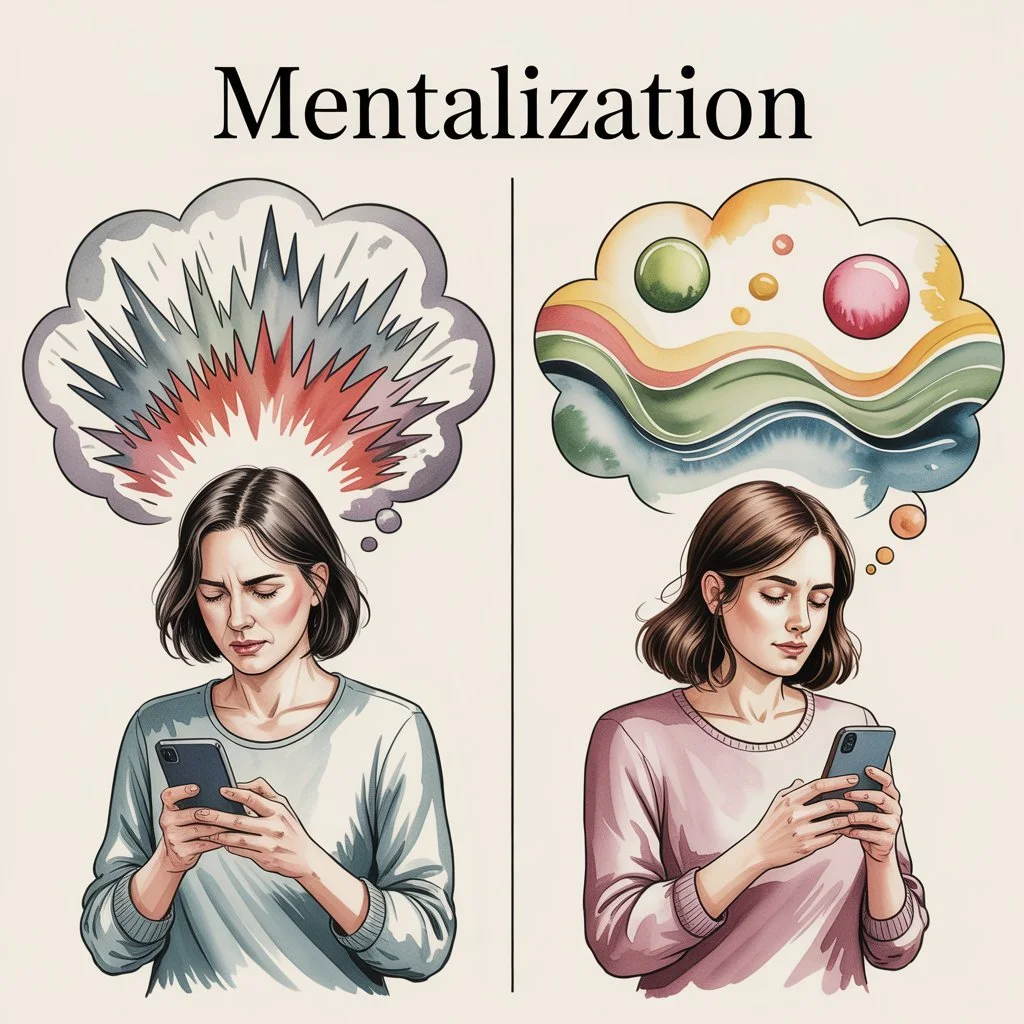
Mentalization means trying to understand what is happening in your mind and in someone else’s mind. It is the ability to pause and wonder:
“What am I feeling right now?”
“What might they be feeling?”
“What could be going on for both of us?”
“Is there more than one explanation?”
Mentalization helps you:
understand your emotions
understand other people better
react less intensely
communicate with more clarity
feel safer and more connected in relationships
Mentalization does not get rid of emotions. It gives you more space to understand them, rather than being controlled by them.
A Simple Example
Imagine you text a friend:
“Want to grab dinner this weekend?”
A whole day passes, with no reply.
When mentalization is low:
“She’s mad at me. I must have done something wrong.”
Your feeling becomes “the truth.”
When mentalization is stronger:
“Maybe she’s overwhelmed, or maybe she forgot. I feel a bit hurt, but I don’t know what’s going on for her yet.”
You stay open, even while feeling your emotions.
Mentalization helps you pause, reflect, and notice possibilities rather than jumping straight into fear or self-blame

2. Why Mentalization Matters
When emotions run high, your brain shifts into survival mode. Curiosity shuts down, and things start to feel urgent and absolute. This can show up in relationships as:
assuming the worst
feeling sure someone is mad at you
reacting quickly without pausing
shutting down and disconnecting
becoming overwhelmed by strong emotions
Mentalization helps you:
✔ Stay steady in stressful moments
You can slow down and check in with yourself.
✔ Respond instead of react
You gain a moment between the feeling and the reaction.
✔ Understand patterns
You notice familiar emotional cycles.
✔ Communicate more clearly
Conversations feel less confusing or explosive.
✔ Repair misunderstandings
You can talk through what happened with more calm and clarity.

3. How Mentalization Develops
Mentalization grows in relationships where emotions are understood, named, and responded to with care. If your caregivers were able to do this, mentalization usually grows naturally.
If your early environment was chaotic, invalidating, frightening, or unpredictable, you may have learned to:
doubt your own feelings
assume the worst
suppress emotions
stay constantly alert for danger
protect yourself by shutting down
These patterns make perfect sense given your history. And they do not mean anything is “wrong” with you. They reflect early experiences, not your worth or abilities.
The hopeful part is that mentalization can grow at any age. MBT is designed to help strengthen it.

4. What MBT Sessions Look Like
MBT sessions are warm, steady, and focused on understanding what is happening for you in the moment.
You can expect:
A slower pace
We take time to explore emotions and the meaning of interactions.
Curiosity instead of certainty
I will not tell you what someone “really meant.” Instead, we think it through together.
Emphasis on feelings before solutions
We look at your emotions, thoughts, sensations, and interpretations before trying to change anything.
Collaboration
You are the expert on your experience. My role is to help you approach your inner world with curiosity and kindness.
Examining moments closely
We might slow down one small moment, because small moments reveal important emotional patterns.

5. Three Ways Mentalization Can Break Down
When emotions become intense, overwhelming, or confusing, mentalization can temporarily collapse. There are three common patterns. These happen to everyone at times.
1. Psychic Equivalence: “My feeling equals the truth.”
Your inner feeling becomes reality.
Example:
“I feel ignored, so I know they don’t care about me.”
This mode feels urgent, absolute, and painful.
2. Pretend Mode: “I’m talking about feelings without really feeling them.”
You may tell a story in a calm or detached way, even if it is emotional.
Example:
“Yes, I was really upset. Whatever.”
The words are there, but the feelings feel distant.
3. Teleological Mode: “If you care, you must prove it.”
Only actions count. Feelings are judged by what you can see.
Example:
“If they loved me, they would hug me right when they got home.”
Love and care are reduced to visible behaviors.

6. How MBT Helps Restore Mentalization
In therapy, we gently identify these modes without judgment. When we notice them, we slow down and help you reconnect with curiosity and reflection.
A typical MBT moment might sound like:
“It feels very real right now that he doesn’t care. Can we pause and explore that feeling together?”
We work together to:
validate your emotional experience
name what is happening
understand the trigger
consider other possibilities
help your body and mind settle
reconnect to a calmer and more reflective state

7. What Progress Looks Like
Mentalization grows slowly and steadily. Progress often feels like:
✔ Noticing your feelings sooner
You identify emotions earlier.
✔ Fewer intense reactions
You pause more often before responding.
✔ Holding multiple perspectives
You can see your side and the other person’s side at the same time.
✔ More balanced relationships
Conflicts feel easier to navigate and repair.
✔ A more stable sense of self
Your inner world feels clearer, more organized, and more understood.
✔ Less fear of strong emotions
Feelings become something you can explore, rather than something that takes over.

8. The “Sweet Spot” for Mentalization
Mentalization works best when emotions are present but not overwhelming. This is the “sweet spot” of emotional arousal.
In the sweet spot, you might say things like:
“I feel anxious my friend hasn’t texted back, but maybe they’re stressed.”
“I feel hurt, and I want to understand what this feeling is about.”
“Part of me thinks I’m being rejected, but I can imagine other reasons too.”
This is the balance MBT helps you cultivate.

9. How to Practice Mentalization in Daily Life
Here are tools you can use outside of therapy.
1. Pause and Name the Feeling
Ask:
“What am I feeling right now?”
Even a single word can help bring you back to awareness.
2. Ask What Else Might Be Going On
“What are three other possibilities?”
This widens your perspective.
3. Stay Curious During Conflict
Try:
“Can you help me understand what was going on for you in that moment?”
It is simple, but powerful.
4. Check Whether Your Reaction Fits the Situation
“Is this reaction about now, or is it reminding me of something earlier in life?”
This helps you separate past from present.
5. Hold Two Realities at Once
You can feel hurt and still see that the other person cares.
You can feel angry and still want to understand.
This is mentalization in action.

10. When Emotions Get Too Intense
Strong emotional states can block mentalization. This can feel like:
yelling
shutting down
withdrawing
assuming the worst
feeling certain someone is angry
feeling disconnected or numb
In therapy, we slow the moment down, breathe, and help you understand the emotion rather than be swept away by it.
This process teaches you that strong feelings are survivable and understandable.

11. How MBT Helps Relationships
MBT is especially helpful if you often feel:
misunderstood
easily hurt
scared of abandonment
stuck in painful patterns
unsure what others feel
confused by your own emotions
Mentalization helps you:
understand others more accurately
express your needs clearly
repair conflicts more safely
feel more connected and grounded
trust relationships more deeply

12. A Helpful Analogy: Clearing Foggy Glasses
Imagine wearing glasses that are foggy. Everything looks unclear, and in the blurry spots, your mind fills in the worst possible explanations.
Mentalization is like gently wiping the fog away.
You see more clearly.
You feel more grounded.
You breathe a little easier.
You make choices with more understanding.
The fog may return at times, especially under stress, but now you know how to clear it.

13. What You Can Expect From Your MBT Therapist
In your work with your MBT therapist, you can expect:
curiosity
openness
collaboration
gentle slowing down
help naming emotions
exploration instead of judgment
warmth and steadiness
respect for your pace and experience
MBT is a partnership. You will explore your thoughts, feelings, and patterns together so you can feel more understood and more in control of your emotional world.
Medical Disclaimer
This guide is for informational and educational purposes only. It is not medical advice and does not establish a clinician–patient relationship with Dr. Henderson. Always consult a qualified medical or mental health professional for diagnosis, treatment, or guidance about your individual care.
References
Bateman, A. & Fonagy, P. (2006). Mentalization-Based Treatment for Borderline Personality Disorder.
Fonagy, P., Gergely, G., Jurist, E., & Target, M. (2002). Affect Regulation, Mentalization, and the Development of the Self.
Allen, J. G., Fonagy, P., & Bateman, A. (2008). Mentalizing in Clinical Practice.
Bateman, A. W., & Fonagy, P. (2016). Mentalization-Based Treatment for Personality Disorders: A Practical Guide.